
22 July 2026 · 8 min read
Why Peptides Degrade in Heat — and What Cold Chain Really Means
"Cold chain" is one of the most overused phrases in the peptide supply conversation, and one of the least examined. It's worth separating the chemistry from the theatre.
What heat actually does
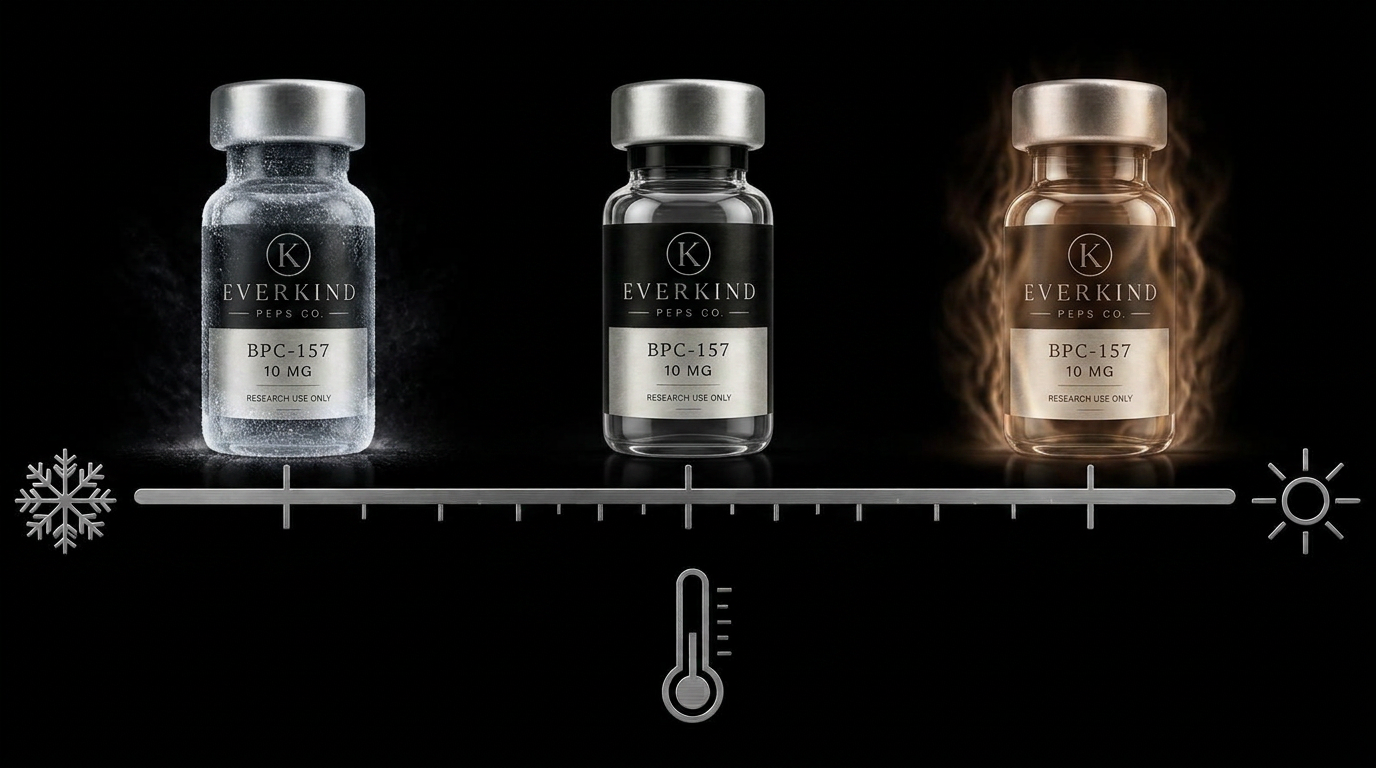
Peptides degrade through several distinct chemical routes, and temperature accelerates all of them.
Hydrolysis. Water attacks the peptide bond. This requires water to be present — which is why the lyophilised form is dramatically more heat-tolerant than the reconstituted one. Aspartic acid and glutamine residues are particularly vulnerable.
Oxidation. Methionine, cysteine and tryptophan residues oxidise in the presence of oxygen and trace metals. Heat speeds the reaction; light catalyses it further.
Deamidation. Asparagine and glutamine residues convert to aspartate and glutamate, changing the molecule's charge and often its activity. Strongly temperature- and pH-dependent.
Aggregation. Heat causes partial unfolding, exposing hydrophobic regions that then stick to one another. Aggregates may be invisible until they aren't.
As a rough working rule from general chemical kinetics, reaction rates approximately double for every 10°C rise. A vial at 40°C is degrading meaningfully faster than one at 20°C — and far faster than one at 4°C.
Why lyophilised powder travels well
Freeze-drying removes the water that hydrolysis needs. A properly lyophilised peptide in a sealed, amber, inert-headspace vial is a genuinely robust object over days-long transit windows, even at ambient temperature.
This is the reason the international research supply chain functions at all. It is also why extreme cold-chain packaging on a lyophilised product is more marketing than chemistry — what matters far more is transit duration, light exposure and avoiding sustained extreme heat.
Reconstituted peptides are a different story entirely. Those genuinely require continuous refrigeration and should never be shipped.
The Australian variables
Two specific to shipping domestically here:
Letterbox and vehicle heat. A parcel sitting in a delivery van or an unshaded letterbox on a 38°C day can reach internal temperatures well above ambient. The single most effective mitigation is a short, tracked transit window and prompt collection — not more ice packs.
Distance. Metro-to-regional routes add days. Express shipping is worth more to product integrity than any amount of insulation on a slow service.
What good practice looks like
From the supply side:
- Ship lyophilised, never reconstituted
- Amber glass, sealed, boxed against light and impact
- Express, tracked service to compress the transit window
- Dispatch early in the week to avoid weekend depot storage
From the receiving side:
- Collect promptly; don't leave the parcel in a hot letterbox
- Inspect the vial — cake should be intact, not melted, shrunken or discoloured
- Move to refrigeration on arrival
- Bring to room temperature before opening to avoid condensation
- Record arrival date and storage conditions
Judging a vial on arrival
A well-preserved lyophilised cake looks like a dry, uniform disc or plug. Warning signs are a collapsed or oily-looking cake, powder that has slumped down one side after being liquid at some point, or discolouration inconsistent with the compound.
EVERKIND ships everything lyophilised in amber vials, packed and dispatched by express courier from our Australian facility for domestic research customers.
Disclaimer: This article is educational only. All compounds discussed are supplied strictly for laboratory research use and are not approved for human or veterinary use.
Research use only. Not for human or veterinary use.