
23 March 2026 · 8 min read
How to Store Peptide Vials: Temperature, Light and Real Shelf Life
Most potency loss in a research setting doesn't come from a peptide being old. It comes from how it was handled in the first fortnight.
Peptides are chains of amino acids held in a specific three-dimensional shape. Break the shape and the molecule may still look fine in solution — clear, colourless, no visible particulate — while behaving very differently in an assay.
Lyophilised (unreconstituted) vials
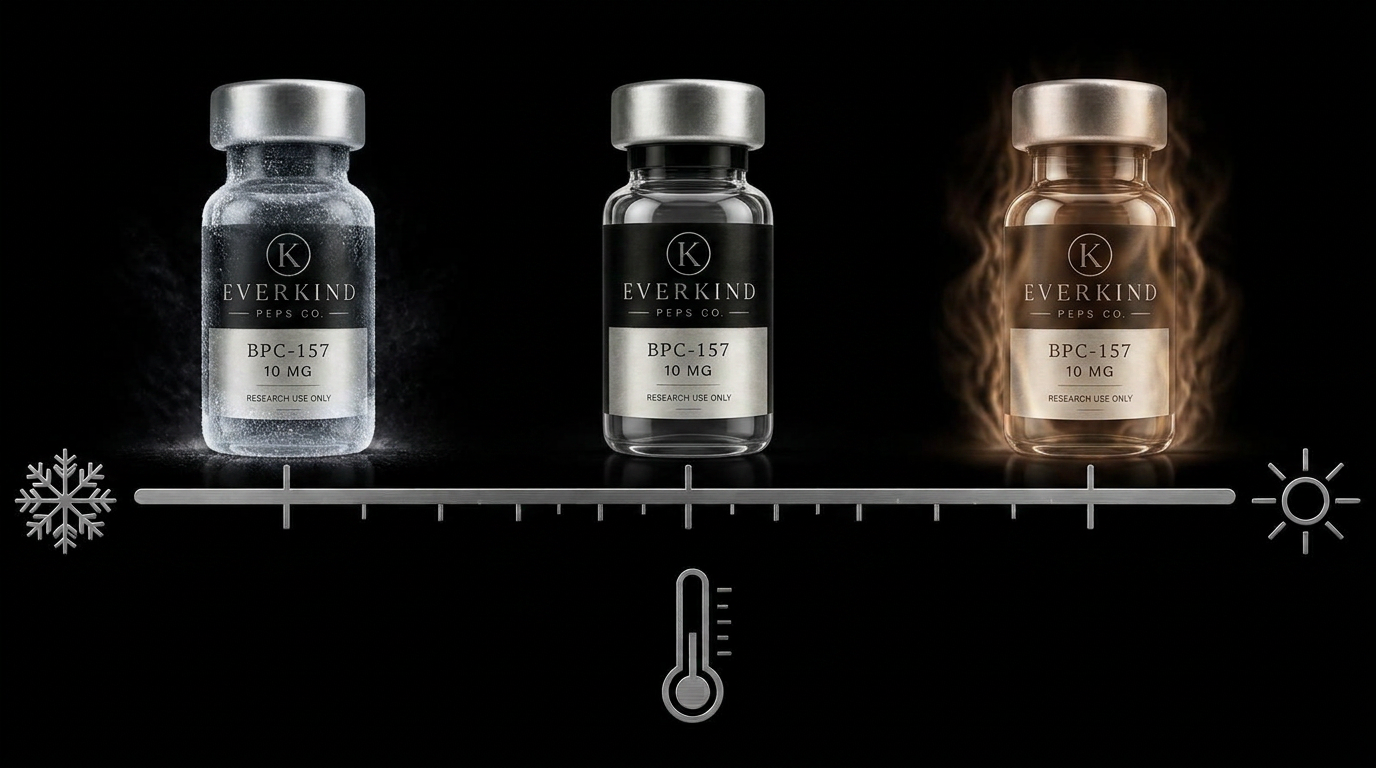
Freeze-dried powder is the stable form. Water is the enemy of long-term peptide stability, and lyophilisation removes it.
- Short term (weeks): room temperature, dark, dry is generally acceptable for transit
- Medium term (months): 2–8°C refrigeration
- Long term (a year or more): −20°C, ideally in a non-frost-free freezer
Always let a cold vial reach room temperature before breaking the seal. Opening a cold vial in a humid room draws condensation onto the powder, and moisture is what starts hydrolysis.
Reconstituted vials
Once bacteriostatic water goes in, the clock changes completely. In solution, peptides face hydrolysis, oxidation, aggregation and adsorption to the vial wall.
- Refrigerate at 2–8°C immediately after reconstitution
- Do not freeze most reconstituted peptides — ice crystal formation shears the molecule
- Typical working stability is measured in weeks, not months, and varies by compound
- Blends are limited by their least stable component
The four things that actually degrade peptides
1. Heat. Degradation rate roughly accelerates with temperature. A vial left in a car boot on a 35°C Australian afternoon experiences more stress in a day than months of correct refrigeration.
2. Light. Tryptophan, tyrosine, cysteine and methionine residues are photosensitive. Amber glass helps; keeping vials boxed helps more.
3. Freeze-thaw cycling. Each cycle is a fresh opportunity for aggregation. Repeated cycling is far worse than continuous storage at a slightly less ideal temperature.
4. Agitation. Shaking creates air-liquid interfaces where peptides unfold. Swirl gently, or let the solvent run down the vial wall — never shake.
A practical protocol
- Store unopened vials cold and dark, in their original packaging
- Bring to room temperature before opening
- Add bacteriostatic water slowly down the inside wall of the vial
- Swirl; never shake or vortex
- Label the vial with the reconstitution date
- Return to refrigeration between uses, and minimise time on the bench
What "expired" really means
A dating code is a conservative estimate under ideal storage, not a cliff edge. A correctly stored vial past its date may still assay well; a badly stored vial well inside its date may not. Storage history matters more than the printed number.
Why this matters for reproducibility
If two runs of the same protocol produce different results, handling variance is a more likely explanation than biology. Documenting storage temperature, reconstitution date and number of cold-chain excursions turns an anecdote into data.
At EVERKIND, everything ships lyophilised, in amber vials, boxed, via express courier from Australia to keep transit windows short. What happens after the parcel lands is the part you control.
Disclaimer: This article is educational only. All compounds discussed are supplied strictly for laboratory research use and are not approved for human or veterinary use.
Research use only. Not for human or veterinary use.