
12 August 2026 · 17 min read
The Peptide Tier List: Which Peptides Have the Most Research Potential in 2026?
Peptides have gone from a niche area of biomedical research to one of the most talked-about categories in modern biotechnology.
Scroll through social media and you'll see the same names repeatedly:
- BPC-157
- TB-500
- GHK-Cu
- Semaglutide
- Tirzepatide
- Retatrutide
- Epitalon
- CJC-1295
- Ipamorelin
- Semax
- Selank
But popularity isn't the same thing as evidence.
A peptide can have thousands of mentions online and very little high-quality research behind it. Another can have relatively little social-media attention but a substantial clinical literature.
So rather than asking "Which peptide is best?", a more useful scientific question is:
Which peptides currently have the strongest combination of biological rationale, research evidence, translational potential and clinical validation?
That's the approach we'll take here.
This is not a ranking of what research subjects should use. It is a ranking of the scientific potential and evidence surrounding commonly discussed peptides.
And there are some significant surprises.
First: What Does an S-to-D Ranking Actually Mean?
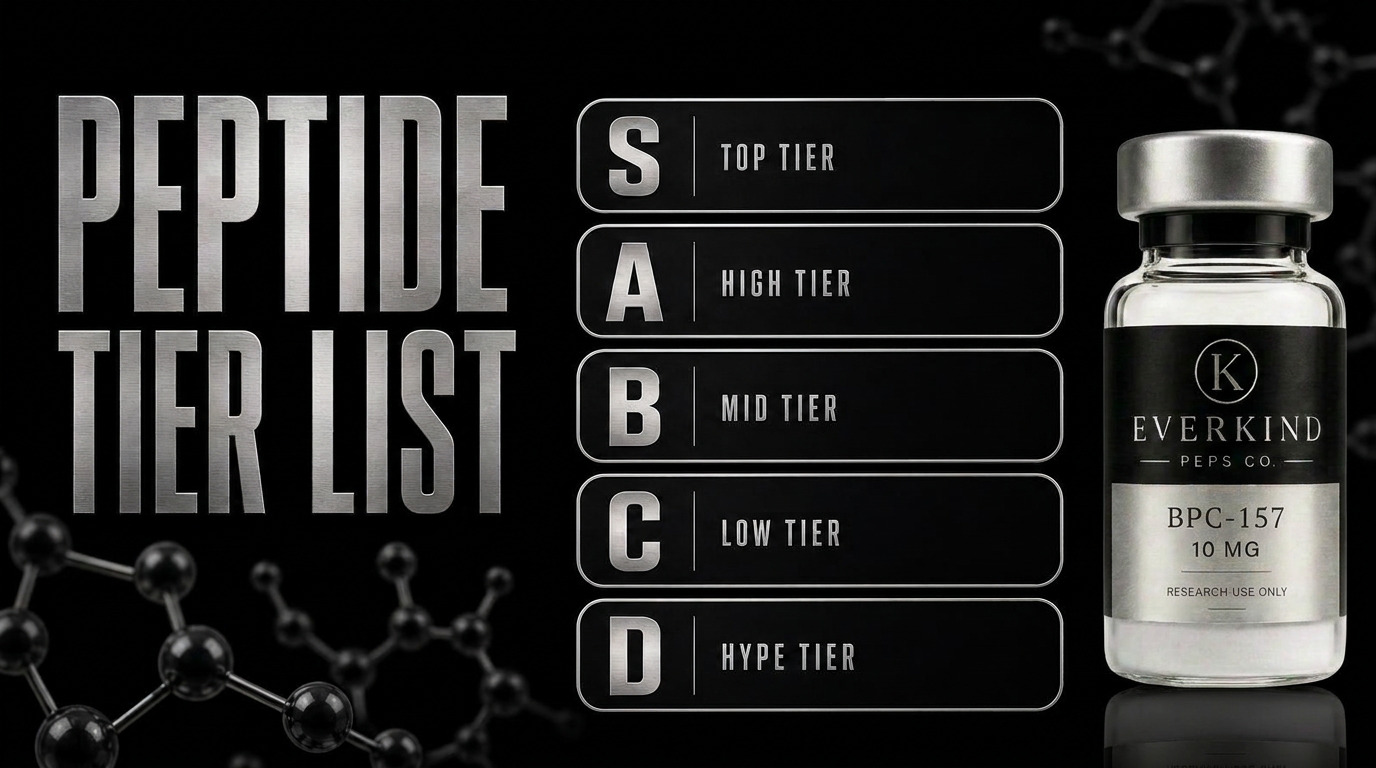
Before putting anything into a tier, we need to define the criteria.
A peptide shouldn't receive an S rating simply because a Phase 2 trial produced an impressive headline. Likewise, a compound shouldn't receive a D rating simply because it hasn't yet been studied extensively.
For this ranking, we'll consider five factors:
- Human evidence: Have controlled clinical trials actually been conducted?
- Quality of evidence: Are we looking at randomized controlled trials, observational research, animal studies or cell experiments?
- Biological plausibility: Does the proposed mechanism make sense based on established physiology?
- Translational potential: Is there a realistic pathway from laboratory research to clinically meaningful applications?
- Regulatory validation: Has the compound actually progressed through the regulatory process?
This last point matters enormously. A peptide that has completed large randomized trials is in a completely different scientific category from a peptide supported primarily by cell culture and animal experiments.
D Tier: High Hype, Serious Uncertainty
Melanotan II
Melanotan II is one of the most recognizable peptides in the appearance-focused peptide market. It is a synthetic analogue of alpha-melanocyte-stimulating hormone and acts on melanocortin receptors. Its ability to influence melanogenesis is what generated much of its popularity.
But the biology of melanocortin receptors is considerably broader than pigmentation. Melanocortin signaling is involved in multiple physiological processes, which helps explain why research into melanotan compounds has reported effects beyond pigmentation.
Reported adverse effects associated with melanotan II research have included nausea, flushing, headache, dizziness, changes in appetite and sexual effects.
There is also a particularly important dermatological issue. Changes in the appearance of pigmented lesions following melanotan exposure can make monitoring suspicious moles more complicated.
That does not mean that melanotan II has been proven to cause melanoma. That distinction is important.
The stronger scientific conclusion is that melanotan II does not have the level of safety and clinical validation that would justify the enormous confidence sometimes seen in online discussions.
Verdict: D
Interesting pharmacology. Weak clinical validation. Too many unanswered questions.
Selank
Selank is a synthetic peptide derived from tuftsin and has attracted attention primarily because of proposed anxiolytic and neuroactive properties.
There is published research on Selank, including studies originating from Russia. The problem isn't that research from one country should automatically be dismissed. The problem is replication.
A promising pharmacological signal becomes much more convincing when independent research groups reproduce the finding using modern methodologies and well-controlled trials. For Selank, the evidence base remains much thinner than the online popularity might suggest.
The mechanistic hypothesis is interesting. The clinical certainty is not.
Verdict: D
Interesting biology, insufficient validation.
AOD-9604
AOD-9604 is a modified fragment derived from human growth hormone and has been marketed heavily within the body-composition research space. Its proposed metabolic effects have made it particularly attractive to the peptide industry.
But marketing strength and evidence strength are two very different things. The available clinical literature does not provide the same level of convincing evidence seen with modern incretin-based therapies.
This is an excellent example of why a peptide can become extremely popular without becoming scientifically compelling.
Verdict: D
Interesting concept. Limited clinical evidence. Significant marketing hype.
C Tier: Real Pharmacology, But Limited Scope or Evidence
Bremelanotide / PT-141
Bremelanotide is an important exception to the "research-only" peptide conversation because it has actually received FDA approval for a specific indication.
The FDA approved Vyleesi (bremelanotide) in 2019 for premenopausal women with acquired, generalized hypoactive sexual desire disorder. It is not approved for men or as a general sexual-performance enhancer.
That makes bremelanotide scientifically interesting. There is genuine clinical evidence. But the evidence is indication-specific. It should not be extrapolated into a general claim that PT-141 is an effective solution for every form of sexual dysfunction.
Verdict: C
Real drug. Real evidence. Narrow indication.
Growth Hormone Secretagogues: Ipamorelin
Ipamorelin is a ghrelin-receptor agonist designed to stimulate growth hormone release. Its attraction is easy to understand.
Growth hormone influences IGF-1, protein metabolism, tissue growth, lipid metabolism and glucose regulation.
But that doesn't automatically mean that increasing growth hormone signaling produces beneficial outcomes in every research context. The important question is not "Does it increase GH?" It is: "Does increasing GH produce a clinically meaningful outcome that outweighs the biological trade-offs?"
That is much harder to demonstrate.
Verdict: C
Strong pharmacological rationale. Interesting research. But considerable uncertainty around long-term implications and meaningful outcomes.
B Tier: Legitimate Scientific Potential
CJC-1295
CJC-1295 is another growth-hormone secretagogue that has attracted substantial attention. The mechanism is scientifically interesting because it is designed to influence growth-hormone-releasing hormone pathways and prolong GH-related signaling.
But once again, increasing a biomarker isn't the same thing as demonstrating a meaningful clinical benefit. CJC-1295 therefore belongs in the B tier rather than the top category.
Verdict: B
Good pharmacological rationale, but translational questions remain.
Thymosin Alpha-1
Thymosin alpha-1 is considerably more interesting than its relatively modest social-media profile might suggest. It is an immunomodulatory peptide that has been investigated in infectious disease, immune dysfunction and other clinical settings. There is a substantial body of published literature.
However, the quality of that evidence is mixed. A 2025 meta-analysis of randomized trials in sepsis found a potential mortality benefit, but the authors noted that higher-quality and multicenter subgroup analyses did not establish a statistically significant benefit and that the available evidence remains insufficient for definitive conclusions.
That is exactly how research should be interpreted. Not "Thymosin alpha-1 saves lives." But: "There is a biological rationale and clinical signal that warrants further investigation."
Verdict: B
A serious research peptide with substantially more clinical literature than many social-media favorites.
Semaglutide
Semaglutide deserves a special category because it demonstrates what happens when peptide pharmacology successfully makes the transition from experimental research into large-scale clinical medicine.
Unlike most compounds on this list, semaglutide is not merely promising. It has extensive clinical evidence and regulatory approvals for specific indications. Its mechanism is also well established: GLP-1 receptor activation leads to increased glucose-dependent insulin secretion, reduced appetite, delayed gastric emptying and metabolic effects.
The reason it isn't S tier in this particular potential ranking isn't because it doesn't work. It is because the scientific landscape has moved forward. Dual and triple agonists are now producing increasingly ambitious results.
Semaglutide represents an enormously important chapter in metabolic medicine. It may not represent the endpoint.
Verdict: B+
Exceptional validation. Mature science. Increasing competition from next-generation therapies.
Epithalon
Epithalon is one of the most fascinating peptides in longevity research. Its proposed mechanism involves telomerase activity and telomere biology.
Recent laboratory research has reported telomere-lengthening effects in human cell lines, including through increased telomerase-related activity.
But here's the critical distinction: cellular telomere extension is not the same thing as demonstrated human lifespan extension. Telomeres are enormously interesting biological structures, but aging is not controlled by a single molecular switch.
Genomic instability, mitochondrial dysfunction, cellular senescence, epigenetic alterations, proteostasis, inflammation and other processes all interact. Epithalon therefore remains an intriguing longevity research candidate rather than an established anti-aging intervention.
Verdict: B
Extremely interesting mechanism. Insufficient clinical validation.
A Tier: Serious Translational Potential
BPC-157
BPC-157 has become one of the most discussed experimental peptides in the world. And there is a reason. Its research profile includes investigations into tissue repair, angiogenesis, gastrointestinal biology, inflammation, vascular signaling, musculoskeletal injury models and neurobiological effects.
The preclinical literature is extensive. But this is precisely where peptide discussions often go wrong. A large number of animal and laboratory studies does not automatically equal proven human efficacy.
BPC-157 remains a compound where the biological signal is interesting enough to justify further investigation, but where high-quality human evidence is still the missing piece. That makes its potential high while its certainty remains relatively low.
Verdict: A
Strong preclinical signal. Major translational gap.
TB-500
TB-500 is commonly discussed alongside BPC-157 because both have been associated with tissue-repair research. Its connection to thymosin beta-4 biology makes the mechanism particularly interesting.
Research involving thymosin beta-4 has investigated angiogenesis, cell migration, tissue repair, wound healing, cytoprotection and inflammation.
But again, the distinction between research involving thymosin beta-4 and commercially marketed products described as "TB-500" needs to be made carefully. They should not automatically be treated as pharmacologically identical.
Verdict: A-
Interesting regenerative biology, but substantial translational and product-definition questions remain.
GHK-Cu
GHK-Cu is probably one of the most interesting peptides in the cosmetic and dermatological research space. It is a naturally occurring copper-binding tripeptide complex associated with extracellular matrix signaling and tissue remodeling.
Research has investigated its potential relationship with collagen, elastin, skin repair, inflammation, wound healing and gene expression. There is also human research involving topical copper tripeptide formulations.
Interestingly, one randomized study following CO2 laser resurfacing found that GHK-Cu skincare did not significantly improve objective measures of erythema or overall skin appearance, although patient satisfaction was higher in the GHK-Cu group.
That is a perfect example of why "studied" doesn't automatically mean "proven." GHK-Cu has genuine biological credibility. But claims about systemic applications remain much less established than the social-media conversation sometimes suggests.
Verdict: A-
Strong dermatological research potential. Much less certainty for broad systemic claims.
S Tier: The Peptides With the Strongest Evidence or Most Transformative Potential
And now we reach the compounds that genuinely stand out.
Number 3: Tirzepatide
Tirzepatide represents one of the most important advances in metabolic medicine. Rather than activating GLP-1 alone, tirzepatide activates GLP-1 and GIP.
That dual mechanism produces powerful effects on body weight and metabolic parameters. The SURMOUNT clinical program demonstrated substantial weight reduction, with the highest-dose group in SURMOUNT-1 achieving around 21% mean weight loss at 72 weeks. Some analyses and individual responses extended beyond that figure.
The important point isn't the exact social-media headline. It's the quality of evidence behind it. Tirzepatide has progressed through large randomized trials, multiple Phase 3 programs, regulatory review, clinical use and long-term outcome research.
That puts it in a completely different evidence category from experimental peptides.
Verdict: S
Extremely strong clinical validation and transformative metabolic potential.
Number 2: Retatrutide
Now things get very interesting. Retatrutide activates GLP-1, GIP and glucagon. This triple-agonist architecture is one of the most ambitious developments in metabolic pharmacology.
The Phase 2 trial published in The New England Journal of Medicine reported up to approximately 24.2% mean weight reduction at 48 weeks at the highest dose studied.
But that is no longer the latest story. By 2026, retatrutide had progressed through multiple Phase 3 trials, with Lilly reporting further substantial weight-loss results, including 28.3% mean weight loss at 80 weeks in TRIUMPH-1's highest-dose group. Additional Phase 3 results have reinforced the strength of the program across different populations.
That makes the compound one of the most important metabolic research programs currently underway.
But there is an important caveat: retatrutide remains investigational. Positive Phase 3 results are not the same as regulatory approval. The difference between "This looks extraordinarily promising" and "This is an approved therapy" is the regulatory process.
Verdict: S+
If the late-stage evidence continues to translate into regulatory approval and long-term safety validation, retatrutide could become one of the defining metabolic therapies of this decade.
Number 1: The Most Important Peptide Category May Not Be a Single Peptide
Here's where a conventional ranking breaks down. The biggest scientific opportunity may actually be the next generation of multi-receptor peptide therapies.
The evolution looks something like this:
- GLP-1
- GLP-1 + GIP
- GLP-1 + GIP + Glucagon
- Next-generation combinations
The significance isn't simply that each new compound produces a bigger number on a weight-loss graph. The real scientific question is whether manipulating multiple metabolic pathways simultaneously can produce better outcomes across adipose tissue, liver fat, glucose metabolism, cardiometabolic risk, appetite regulation, energy expenditure and inflammation.
That is where the field is heading. And retatrutide is currently one of the clearest demonstrations of that strategy.
The Final Peptide Tier List
S+ — Retatrutide: Exceptional late-stage metabolic research potential.
S — Tirzepatide: Extensive clinical evidence and major metabolic impact.
A — BPC-157: Strong preclinical research; human evidence remains limited.
A- — TB-500 and GHK-Cu: Interesting regenerative and dermatological biology.
B — Epithalon, CJC-1295 and Thymosin Alpha-1: Genuine research base, but important evidence gaps remain.
B+ — Semaglutide: Exceptional clinical validation with an earlier-generation mechanism.
C — Ipamorelin and Bremelanotide (PT-141): Real pharmacology, but narrower applications and evidence.
D — Selank, AOD-9604 and Melanotan II: Interesting concepts with limited convincing validation.
But Here's the Problem With Any Peptide Tier List
The ranking can change. Fast.
That's because peptide research is moving at an extraordinary pace. A compound sitting in the B tier today could move into A if a well-designed clinical trial produces compelling results. A compound sitting in A could fall if larger studies fail to reproduce earlier findings. And a compound sitting at S could ultimately fail because of long-term safety issues.
That is exactly why potential should never be confused with proof.
The Evidence Pyramid Matters More Than the Tier
When evaluating any peptide, think about the evidence hierarchy.
Level 1 — Anecdotes: "I tried it and felt amazing." Interesting. Not strong evidence.
Level 2 — Mechanistic theory: "This peptide activates pathway X." Useful. Still not proof of clinical benefit.
Level 3 — Cell studies: The peptide changes something in cultured cells. Interesting, but highly preliminary.
Level 4 — Animal research: The compound produces an effect in mice or another model. More informative, but still not equivalent to human evidence.
Level 5 — Early human studies: Now we have evidence that the biology can translate. But small studies can produce misleading signals.
Level 6 — Randomized controlled trials: This is where things become much more convincing.
Level 7 — Large Phase 3 programs plus regulatory validation: This is where a peptide transitions from interesting science into established medicine.
That's why semaglutide and tirzepatide deserve fundamentally different treatment from compounds supported primarily by preclinical studies.
Why Social Media Can Get Peptides So Wrong
One of the biggest problems in peptide research today is the collapsing of these categories.
A social-media post might say "BPC-157 heals tendons." But the underlying evidence may largely involve laboratory and animal models.
Another post might say "Epithalon reverses aging." But the evidence may involve cellular mechanisms rather than demonstrated lifespan extension in humans.
Another might say "Retatrutide is the best peptide ever." That is also premature. It may ultimately become one of the most important metabolic therapies of the decade. But the appropriate scientific position is: the evidence is exceptionally promising, and the clinical development program is unusually advanced.
That's a much stronger statement than hype.
The Everkind Perspective
At Everkind Research, we supply peptides for controlled scientific investigation. We do not endorse specific compounds, combinations or dosing protocols. Our interest is in helping researchers access high-quality material for well-designed studies.
When we look at the peptide landscape, the compounds that deserve the most attention are not necessarily the most popular ones. They are the ones with the clearest mechanisms, the strongest evidence and the most transparent development pathways.
Quality, traceability and independent verification matter more than marketing claims.
What About the "Miracle Peptide" Problem?
There is no single peptide that has been proven to simultaneously build muscle, repair every injury, reverse aging, improve cognition, burn fat, restore joints, improve skin, increase longevity and prevent disease.
When one compound is marketed as doing everything, skepticism is warranted. Biology doesn't usually work that way.
The most credible peptide therapies tend to have specific mechanisms and specific endpoints. That's why the strongest compounds in this ranking are not necessarily the ones with the longest list of claimed benefits. They are the ones where the evidence is strongest for a clearly defined biological effect.
The Most Important Lesson
The peptide revolution isn't really about finding a magical molecule. It's about learning how to manipulate biological signaling with increasing precision.
First-generation peptide therapies targeted individual pathways. Then came dual agonists. Now we're seeing triple agonists. And the next generation will likely become even more sophisticated.
That is the part of peptide research worth watching. Not the influencer rankings. Not the miracle claims. Not the anecdotal testimonials. The trials.
Final Verdict
If we rank peptides based on scientific potential rather than internet popularity, the landscape looks very different.
Retatrutide currently stands out because of the strength and scale of its late-stage metabolic research. Tirzepatide has already demonstrated what a dual incretin strategy can accomplish through extensive clinical research. Semaglutide remains one of the most important peptide-derived medicines ever developed.
BPC-157, TB-500, GHK-Cu and Epithalon remain fascinating research candidates, but their evidence should not be confused with that of approved metabolic medicines.
And compounds such as Selank, AOD-9604 and Melanotan II demonstrate why popularity alone is a terrible way to rank scientific credibility.
The future of peptide research isn't about believing everything. It's about knowing what we know, what we don't know, and what still needs to be tested.
Research Disclaimer
This article is intended for research and educational purposes only. The tier rankings represent an assessment of research potential and evidence strength, not recommendations for use by research subjects. Experimental compounds should not be treated as approved therapies, and preclinical findings should not be presented as established clinical outcomes. Regulatory status can change as new clinical data emerge.
Disclaimer: This article is educational only and summarises published scientific literature. Compounds discussed remain investigational and are not approved for general therapeutic use in most jurisdictions. Nothing here is medical advice. Research use only.
Research use only. Not for human or veterinary use.