
20 April 2026 · 10 min read
GLOW vs KLOW: Which Multi-Peptide Blend Fits Your Research Design?
Multi-peptide blends are convenient and analytically awkward at the same time. They let a single model touch several overlapping pathways; they also make attribution harder. Understanding exactly what's in the vial is the difference between a useful result and an uninterpretable one.
What GLOW contains
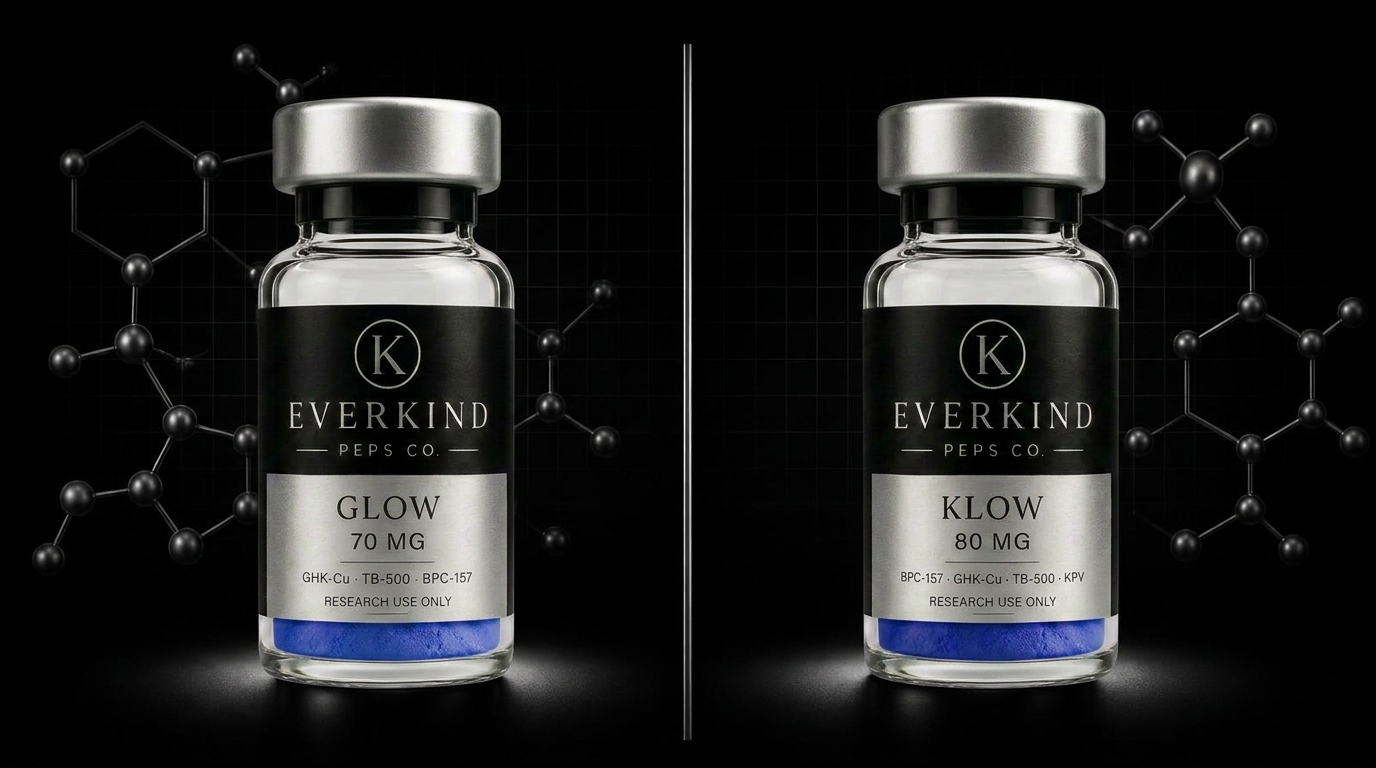
A three-component blend:
- GHK-Cu 50mg
- BPC-157 10mg
- TB-500 10mg
Its research scope sits largely in structural biology: extracellular matrix signalling, cellular migration, tissue remodelling pathways, copper-binding mechanisms, angiogenic signalling and cytoskeletal organisation.
Think of GLOW as structure, matrix, movement and vasculature.
What KLOW contains
Everything in GLOW, plus a fourth peptide:
- GHK-Cu 50mg
- BPC-157 10mg
- TB-500 10mg
- KPV 10mg
Critically, KLOW does not increase the concentration of the first three components. It introduces one additional variable.
KPV — a tripeptide fragment derived from alpha-MSH — is studied in relation to:
- NF-κB inflammatory signalling
- PepT1-mediated cellular uptake
- Epithelial barrier biology
- Alpha-MSH-derived signalling pathways
So KLOW is structure, matrix, movement, vasculature — plus inflammatory and barrier signalling.
Component by component
GHK-Cu
The highest-concentration component in both blends, and the reason both are studied so heavily in skin and matrix models. Research interest covers copper transport, gene expression signalling, collagen-related models and tissue remodelling. Because the concentration is identical in both formulations, matrix-focused designs can use either.
BPC-157
Investigated for angiogenic mechanisms, VEGFR2 interactions, vascular biology and tissue integrity models. It provides the primary vascular-response component shared across both blends.
TB-500
Brings a distinct dimension: G-actin regulation, cytoskeletal organisation and cell migration. Where BPC-157 research clusters around vasculature and signalling, TB-500 research clusters around cell movement and remodelling.
KPV
The differentiator. Inflammatory signalling and epithelial barrier biology are separate research questions from matrix remodelling, and KPV is the only component in either blend that addresses them directly.
Choosing between them
Neither blend is superior. They answer different questions.
- Studying matrix, collagen and vascular pathways? GLOW's three components keep interpretation simpler.
- Studying inflammatory signalling or barrier biology alongside repair pathways? KLOW's fourth component is the reason it exists.
- Studying one mechanism in isolation? Use a single peptide. A blend will not let you attribute an effect cleanly, no matter how good the model is.
Handling notes
Blends are limited by their least stable component, so treat them conservatively:
- Store lyophilised, cold and dark until reconstitution
- Refrigerate after reconstitution and use within a shorter window than you'd allow a single peptide
- Avoid freeze-thaw cycling entirely
- Document reconstitution date on the vial
GHK-Cu-containing blends carry a characteristic blue colouration in solution from the copper complex — expected, not a defect.
EVERKIND stocks KLOW as a research blend, with the ingredient breakdown printed on the vial face so the composition is never ambiguous at the bench.
Disclaimer: This article is educational only. All compounds discussed are supplied strictly for laboratory research use and are not approved for human or veterinary use.
Research use only. Not for human or veterinary use.